
Product Design
This 1908 Book Has 507 Ways to Make Things Move
Henry T. Brown’s mechanical reference is free to read and reuse. Its gears, cams and linkages are still excellent starting points for modern makers.
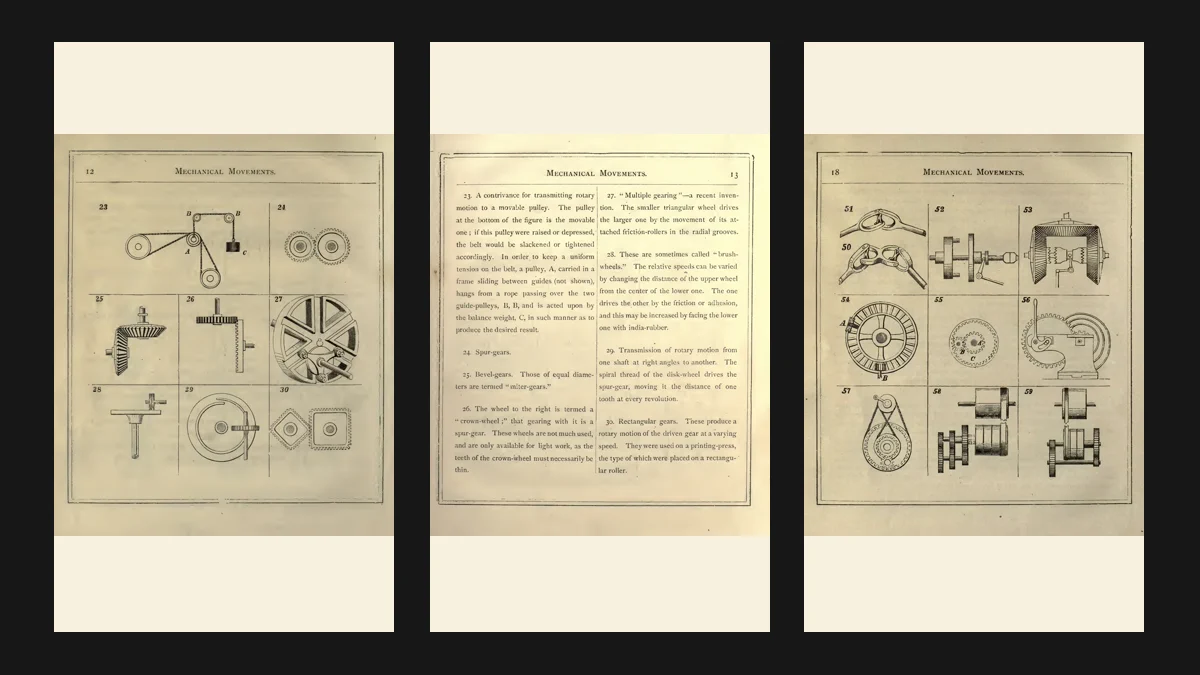
Before “add motor”, people had options
Henry T. Brown’s Five Hundred and Seven Mechanical Movements is exactly what the title threatens: page after page of gears, cams, ratchets, linkages, pulleys and peculiar arrangements for turning one kind of motion into another.
The book first appeared in the nineteenth century. The online edition uses the 1908 twenty-first edition, and it remains surprisingly useful if you design automata, kinetic signs, folding furniture, jigs or anything else that needs to move without adding six servos and a software update.
Browse the animated index here. There is no account or payment required.
Four places to lose an afternoon
Start with movement 75, a classic ratchet for allowing motion in one direction. Movement 96 shows a cam and follower. Movement 215 demonstrates a Geneva mechanism for turning continuous rotation into distinct steps. Movement 246 is a pantograph linkage—the old mechanical trick behind copying movement at a different scale.
Carnegie Mellon’s kinetic-systems course points students to those same examples because the collection is not simply antique decoration. These mechanisms are building blocks. A laser cutter, CNC router or 3D printer can make experimental versions quickly, provided the pivots and clearances are designed properly.
Do not trace one tiny scanned drawing and immediately expect a working production mechanism. The book explains movement, not your material thickness, load, wear or safety factor.
The useful copyright distinction
The original 1908 book is public domain, and a complete scan is available through Wikimedia Commons and the Internet Archive. The static text and drawings can be reused subject to the law where you live.
The modern 507movements.com animations and website layout are separately copyrighted. The site explicitly asks people not to copy or convert the animations. Link to them. Do not quietly turn them into your own GIF pack.
Try this first
Choose one mechanism and rebuild it as three flat layers: base, moving parts and spacers. Make the first version from card with split pins. If the motion makes sense in cheap material, move to plywood or printed parts and start tuning the clearances.
One mechanism is a project. Five hundred and seven is how the garage becomes uninhabitable.