Illustration
This Artist Draws Whole Cities With a Typewriter
James Cook uses letters, punctuation and old typewriters to draw detailed cityscapes, hiding tiny messages and tonal shading inside every keystroke.
This is graphic design on hard mode
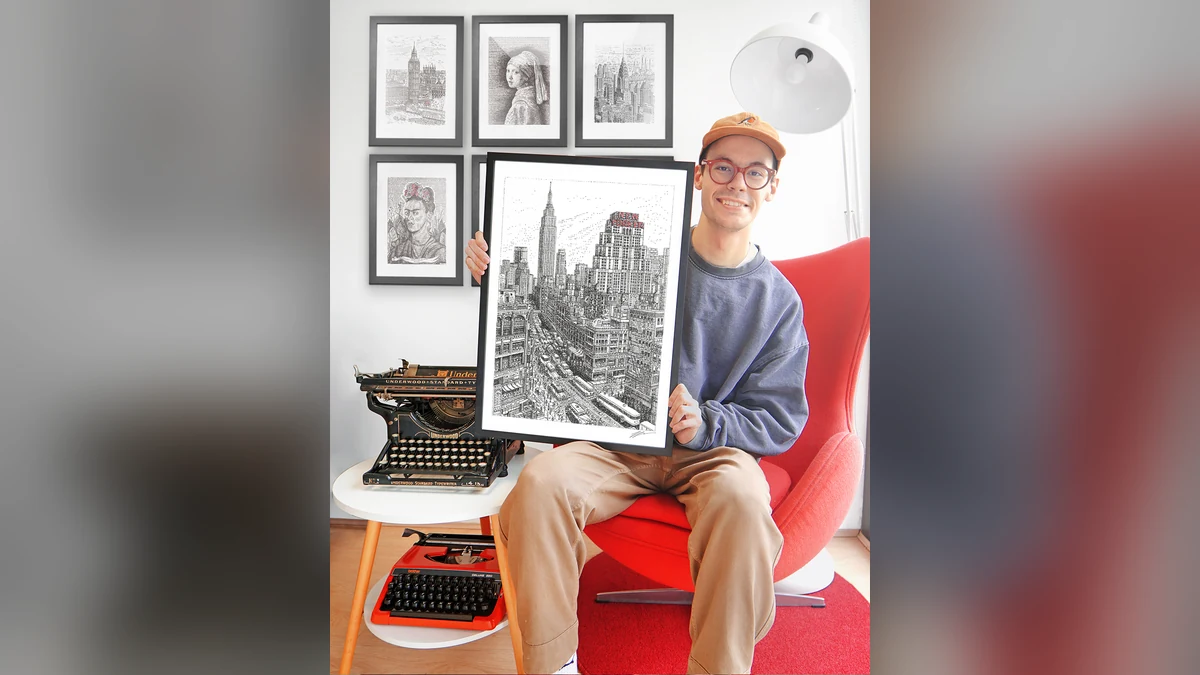
James Cook makes drawings with a typewriter. Not type on top of drawings. The letters, numbers and punctuation are the drawing.
From a normal viewing distance, his work looks like an architectural sketch. Get closer and the windows, shadows and brickwork break apart into rows of characters struck at different pressures. It is a wonderfully inconvenient way to make an image, which is precisely why it is so good.
Cook says a typical machine gives him just 44 keys to work with. He overlaps marks, changes pressure to build tone and sometimes joins multiple typed sections into one enormous picture. A piece can take anywhere from a week to three months.
Have a proper look through James Cook’s gallery before you dismiss the typewriter in your cupboard as a heavy beige email machine.
The limitation became the style
Cook began experimenting with typewriter art in 2014 while investigating unusual creative tools at school. His first machine was a lime-green 1950s Oliver Courier bought for £15. It survived his first 50 drawings before giving up, which feels fair.
The useful lesson is not that everyone needs to buy a vintage typewriter. It is that a tight limitation can make work more recognisable. Forty-four marks. One ink ribbon. No undo button. Every decision has to earn its place.
Cook now has more than 100 typewriters and has made hundreds of works. His subjects include buildings, portraits and large city scenes. Some contain names, coordinates and tiny messages that reward anyone nosy enough to inspect them.
Steal the exercise, not the artwork
Try the idea with your own tools. Pick one photograph and reduce your palette brutally: five rubber stamps, one continuous line, three pen widths, a single embroidery stitch or one sheet of cut vinyl. The goal is not to imitate Cook’s typewriter drawings. It is to discover what your own limitation looks like.
That is the clever bit here. The obsolete machine is not a prop. Its restrictions are the visual language.
Try this first: Rebuild a simple local landmark using only letters, numbers and punctuation in black and white. If it still reads as a thumbnail, the idea is working.