Sound & Audio Design
A Maker Printed an Entire Song on Eight QR Codes
Paper Tunes turns a two-minute track into a 21 KB neural representation, prints it on paper and rebuilds the audio without a streaming service.
The QR codes contain the music, not a link
Most music QR codes are glorified signposts. Scan one and it opens Spotify, YouTube or a website that will probably disappear three weeks after the wedding.
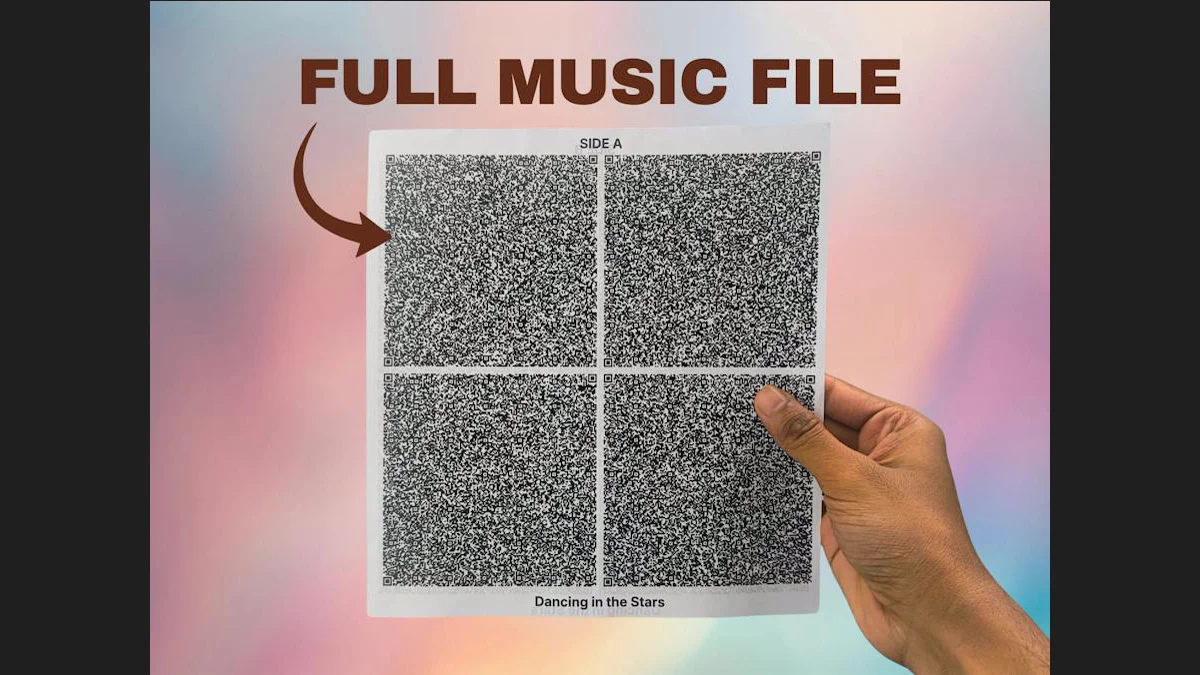
Makestreme’s Paper Tunes project is stranger. The eight QR codes hold the compressed data needed to reconstruct a two-minute song. No cloud library. No streaming link. The paper itself carries the payload.
The complete Paper Tunes build is published on Hackster, including code, printable layouts and the LoRa experiment that followed it.
A normal MP3 would need a wallpaper roll
The original track was about 2.9 MB. A large QR code holds only a few kilobytes, so printing the MP3 directly would require close to a thousand codes.
Makestreme instead used Meta’s open-source EnCodec neural audio codec. At the chosen 3 kbps setting, the song became roughly 21 KB of discrete data. That was split into eight numbered chunks: four QR codes on side A and four on side B, like a cassette designed by somebody who distrusts both tape and convenience.
Software scans the codes, puts the chunks back in order and runs the data through the matching EnCodec decoder to produce audio again.
Paper is only half the player
This is not an immortal record. Damage one densely packed code and the low error-correction setting leaves little redundancy. The sheet also depends on Python, EnCodec and a compatible decoder environment. Without that software, it is eight attractive squares having a private conversation.
Audio quality is heavily compressed. The creator reports that 3 kbps remained surprisingly listenable, while 1.5 kbps degraded badly. EnCodec itself officially supports recent macOS and mainstream Linux; its repository warns that Windows support is limited and mobile platforms are not supported.
The Paper Tunes project is marked GPL3+, while EnCodec’s code is MIT licensed. Use music you recorded or have permission to reproduce. A clever storage format does not cancel copyright.
Try this first
Before installing anything, listen to the project sample and inspect the printable cassette. If you want to reproduce it, start with ten seconds of your own voice rather than a commercial song. The best first result is proving that data survived paper—not trying to launch an offline record label by dinner.