
Videography
A Film Made From 5,200 Pieces of Pottery Has More Than 10 Million Views
Studio Eeksaurus animated a bird conservation story on real ceramic surfaces. The clever lesson is how they fixed an early test that looked too flat.

At a glance, the blue patterns in The Godawan could pass for painted backgrounds. Then the camera and light reveal the edges. They are plates, tiles, jars and fragments, photographed as physical objects. Studio Eeksaurus built a bird conservation film out of more than 5,200 ceramic pieces, and the official film had passed 10 million YouTube views by 5 November 2026.
That number gets your attention. The useful part for anyone making videos is smaller and stranger: the crew's first ceramic test looked too much like a flat digital animation. They had to make the real material more visible, not more perfect. If your own video work is starting to look interchangeable, there is a decent lesson in that.
| The quick version | |
|---|---|
| What it is | A 2026 conservation film for Godawan Estuary, directed by Suresh Eriyat at Studio Eeksaurus |
| What you can inspect | The finished film, the studio's making-of and a detailed director interview |
| What you can borrow | Put artwork on a physical surface, then use depth, shadows and camera movement to make the surface matter |
| The catch | Thousands of ceramics and a professional crew are not a weekend project; the small experiment below tests one idea, not the studio's entire method |
The pottery is doing a job
The film tells the story of the Great Indian Bustard, a bird associated with Rajasthan. The client is a whisky brand named after that bird, so this is a commissioned brand film, not an independent wildlife documentary. The medium is still a thoughtful choice. Jaipur blue pottery is connected to the region and to the brand's existing design language. A film about a fragile species told through a fragile material has more going on than a pretty blue colour palette.
According to Studio Eeksaurus, the team first made 2D drawings and animation, then transferred successive images onto ceramic surfaces and photographed the objects. The brand's production account puts the scale at more than 5,200 pieces, 15,000 hours and around 100 contributors. The finished work also combines stop motion with 2D animation and live action. It is not a case of someone moving one plate around the kitchen table and finishing before lunch.
In the director interview published on 2 November, Eriyat explains why they did not simply ask artisans to fire every finished frame. Firing can damage or change a piece. The animation was designed first, then placed onto ceramics by different means depending on the shot, including manual and digital transfer. The physical surfaces still carried the image in front of the camera.
That distinction matters. You can admire the craft without making the incorrect claim that every moving mark was hand-painted directly in a kiln-fired glaze. The director is quite open about the mixture of processes. I find that more interesting than a tidy but misleading “all handmade” headline.
Their first result was too clean
Here is the bit I would show a videographer before any of the production numbers. Eriyat says an early scene with ceramic tiles looked disappointingly like ordinary 2D animation. The team had gone to the trouble of using real objects, but the camera was not telling you that.
Stop-motion director Aman Gupta and cinematographer Arun Kumar changed the arrangement. Instead of lining the tiles up flat, they stacked surfaces at different levels and added other objects. The image gained depth and shadows. They also pulled back some of the smoothness in the motion so small physical imperfections could come through. You can see the difference between a decorative texture and a material that actually shapes the shot.
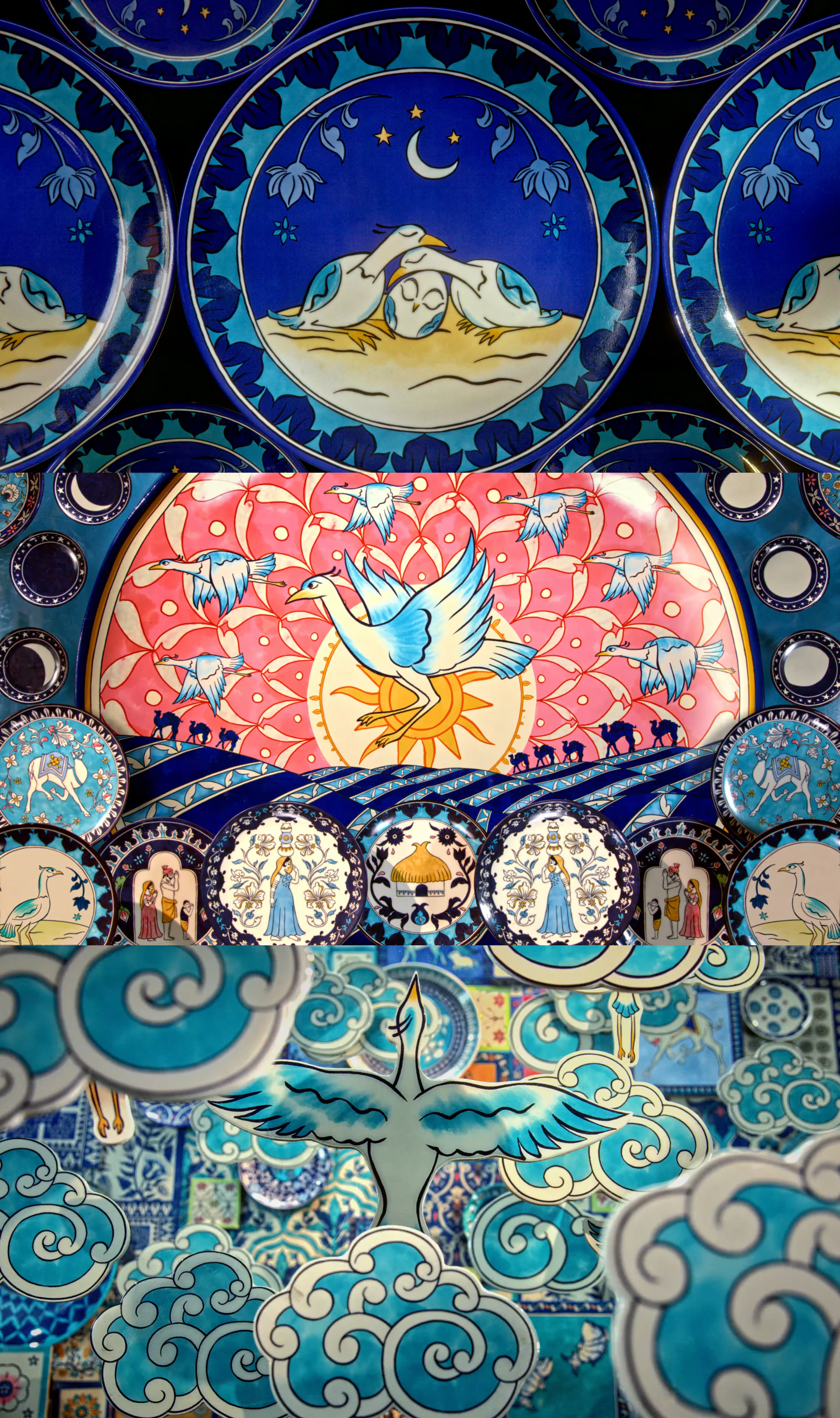
The same problem turns up in maker photos. Put a finished object square to the camera against a plain background and it can look like a render. Move half a step, let one edge catch the light and include the offcuts or the table, and suddenly the viewer understands what they are looking at. The lesson here is not “make everything rough.” It is: if the real material is the reason you chose the idea, give it a way to show itself.
The same interview describes the music arriving early enough to guide the story. Eriyat wrote a lyrical structure, the team developed the song, and the shots were planned against that rhythm. The little egg that narrates the film was a story decision before it was a ceramic one. A material trick on its own does not carry a film; it needs a reason to be there.
Try the useful part without making 5,200 plates
I have not reproduced Eeksaurus's ceramic process. This is a small comparison you can run with a phone and things already on your bench. You are testing whether depth and surface light make your own artwork feel more physical.
- Draw one simple bird, flower or geometric shape on six pieces of paper. Change its position slightly on each piece. Keep the drawing bold enough to read from a phone screen.
- Fix the phone in one position. A tripod is handy, but a firm stack of books works if it cannot wobble. Lock focus and exposure if your camera app permits it; otherwise, keep the lighting steady.
- Photograph the six drawings flat on a table, replacing one after another. This is your deliberately plain comparison.
- Now put those same drawings on six plain coasters, scrap tiles or pieces of stiff card. Stagger the surfaces with small spacers so their edges and shadows appear. Photograph the same six positions again.
- Play each set of stills in order. You can use any editor that imports images as frames. Keep both versions at the same speed and compare them side by side.
Do not use loose ceramic pieces near the edge of a table, and there is no reason to break or fire anything for this test. If you use someone else's artwork on the surfaces, keep the result private unless you have permission to publish it.
What should you look for? In the second version, can you identify the surface without being told? Do the shadows help, or do they hide the drawing? If the phone shifts between frames, that camera wobble may distract more than the material helps. Fix that before adding more objects. You are after one controlled comparison, not a miniature version of an eight-month production.
My call
The official making-of film is worth watching after the finished piece, because the two answer different questions. The film shows what the audience feels; the making-of shows what the crew had to solve. The director says that, on a good day, the team might finish only two or three seconds of film. That should cure anyone of the idea that choosing a “practical” technique automatically makes production cheap.
Would I recommend this as a model for every product video? No. If a client needs a clear thirty-second demonstration tomorrow, moving hundreds of surfaces is probably the wrong answer. But for a campaign, music video, title sequence or personal film where the material is part of the story, The Godawan is a cracking reminder to give the camera something real to discover.
Start with the full film. Then watch the making-of and try that six-frame flat-versus-stacked comparison with your own design. You will learn more from the two versions than from another hour spent choosing an animation preset.
Sources
Share this article
Know someone who would enjoy this? Pass it along.