Exhibition & Spatial Design
This Crochet Reef Is Big Enough to Walk Through
Indonesian artist Mulyana turns recycled yarn and thousands of crocheted pieces into huge underwater worlds—and a useful lesson in modular design.
Someone crocheted the ocean
Indonesian artist Mulyana does not crochet polite little coasters. He makes entire underwater ecosystems.
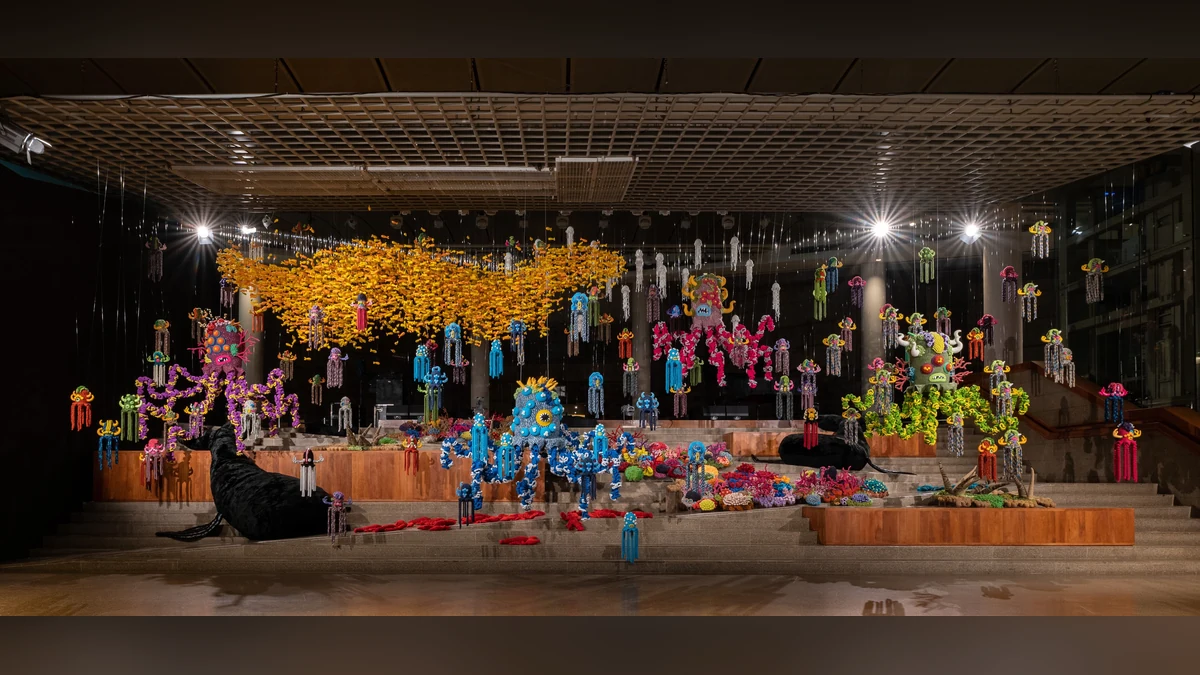
His installations fill galleries with coral, fish, tentacles, bones and strange creatures called Mogus. Everything has the soft, familiar texture of yarn, but the scale makes it feel less like craft and more like walking into a reef after it has developed a very good colour palette.
In 2026, Mulyana: Vital Ecosystems transformed the Eskenazi Museum of Art into a huge marine landscape. The works used hand-knitted and crocheted forms made with materials including surplus yarn from textile factories and plastic bags from food delivery.
See the real installation at the Eskenazi Museum. The photographs do more work than any tidy little description can.
One object became a whole world
Mulyana started knitting while working in a bookstore in Bandung. His work grew from individual characters into modular environments made with communities of knitters in Indonesia.
That modular part is the useful design lesson. A massive installation does not need to begin as a massive object. It can begin with one repeatable unit: a spiral, a branch, a blob, a fish, a flower. Change the scale and colour, make hundreds, then arrange them into a place.
It is a useful thought for exhibitions, window displays, market stalls and community projects. Stop asking how to fabricate one heroic object. Ask what small thing a group of people could make repeatedly without every piece needing to match.
The handmade bit is the spectacle
From a distance, the reef is theatrical. Up close, every loop shows the time and labour inside it. That tension matters. The work is playful enough to pull people in, then detailed enough to keep them there.
For makers, it is proof that familiar materials do not need to produce familiar outcomes. Yarn does not have to become a jumper. Paper does not have to become a card. Offcuts do not have to stay offcuts.
Try this first: Design one palm-sized module that can be made in under 20 minutes. Produce it in five sizes and three colours, then test a wall-sized arrangement before committing to a room.