Exhibition & Spatial Design
One Robot, 1,000 Printed Parts and a Wall of Pixel Art
P.A.R. uses one moving robot to flip 666 physical pixels, replacing hundreds of individual actuators with a gloriously slow mechanical drawing machine.
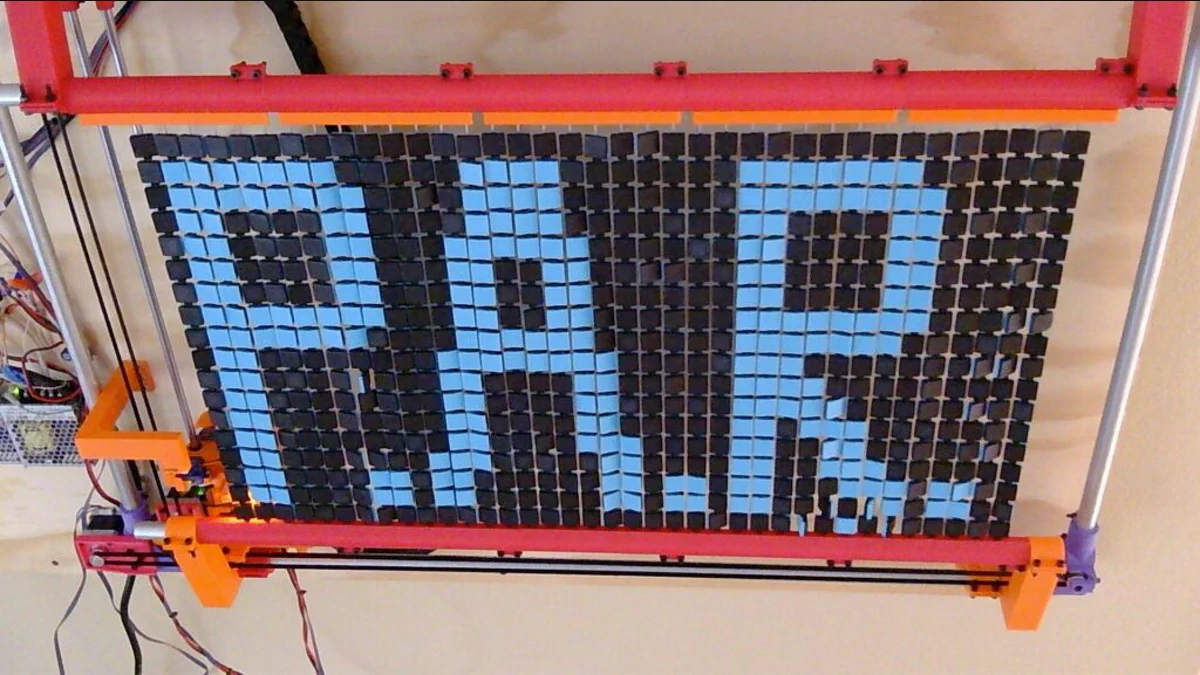
It prints pictures one square at a time
P.A.R. is a 37 × 18 display made from 666 little square tiles. Each tile is dark on one side and bright cyan on the other. A picture appears when the correct tiles are flipped.
A normal flip-disc board hides an actuator behind every pixel. Maker Zimm chose a much slower and more entertaining solution: one robot moves behind the entire wall and physically pokes the squares over one at a time.
The project calls the squares “squisks”, which is unnecessary and therefore perfect.
See the real build, CAD and source links on Hackaday.io. Visitors can also submit pixel art through the project website and watch the machine draw it.
One complicated robot replaced 666 simple actuators
The moving head travels on a two-axis gantry like a vertical plotter. A colour sensor checks which side of each squisk is visible. A servo-driven pin flips only the pixels that need to change, then the system scans again and corrects mistakes.
An Arduino Nano ESP32 handles control and connectivity. The display contains more than 1,000 printed parts once the frame, mechanisms and 666 hand-assembled squisks are counted.
It is painfully slow compared with an LED screen. That is the point. Watching the image arrive is the artwork, in the same way a pen plotter is more mesmerising than a page appearing from an office printer.
Slow can be the cheaper architecture
P.A.R. trades speed for a smaller actuator count. A train departure board needs every character immediately, so one roaming robot would be absurd. An art wall can take its time.
That is a useful design question: does every element need its own motor, light or sensor, or can one moving mechanism visit many elements in sequence? The answer can radically change cost, wiring and maintenance.
The code, CAD and rough parts list are publicly linked by the creator. The GitHub repository does not display a clear licence in the overview we checked, so public access should not be mistaken for automatic commercial permission.
Try this first
Draw a 37 × 18 black-and-white image in the project’s browser interface and see what survives at 666 pixels. Then sketch a smaller physical version using six or twelve flipping tiles and one manual sliding tool.
You will learn very quickly whether the magic is the final picture or the ridiculous journey required to make it.