
Making & Fabrication
NASA’s little folding rover has a trick worth trying in cardboard
JPL’s origami-inspired scout changes shape to squeeze under rocks. The useful lesson starts with a piece of card and an awkward gap.
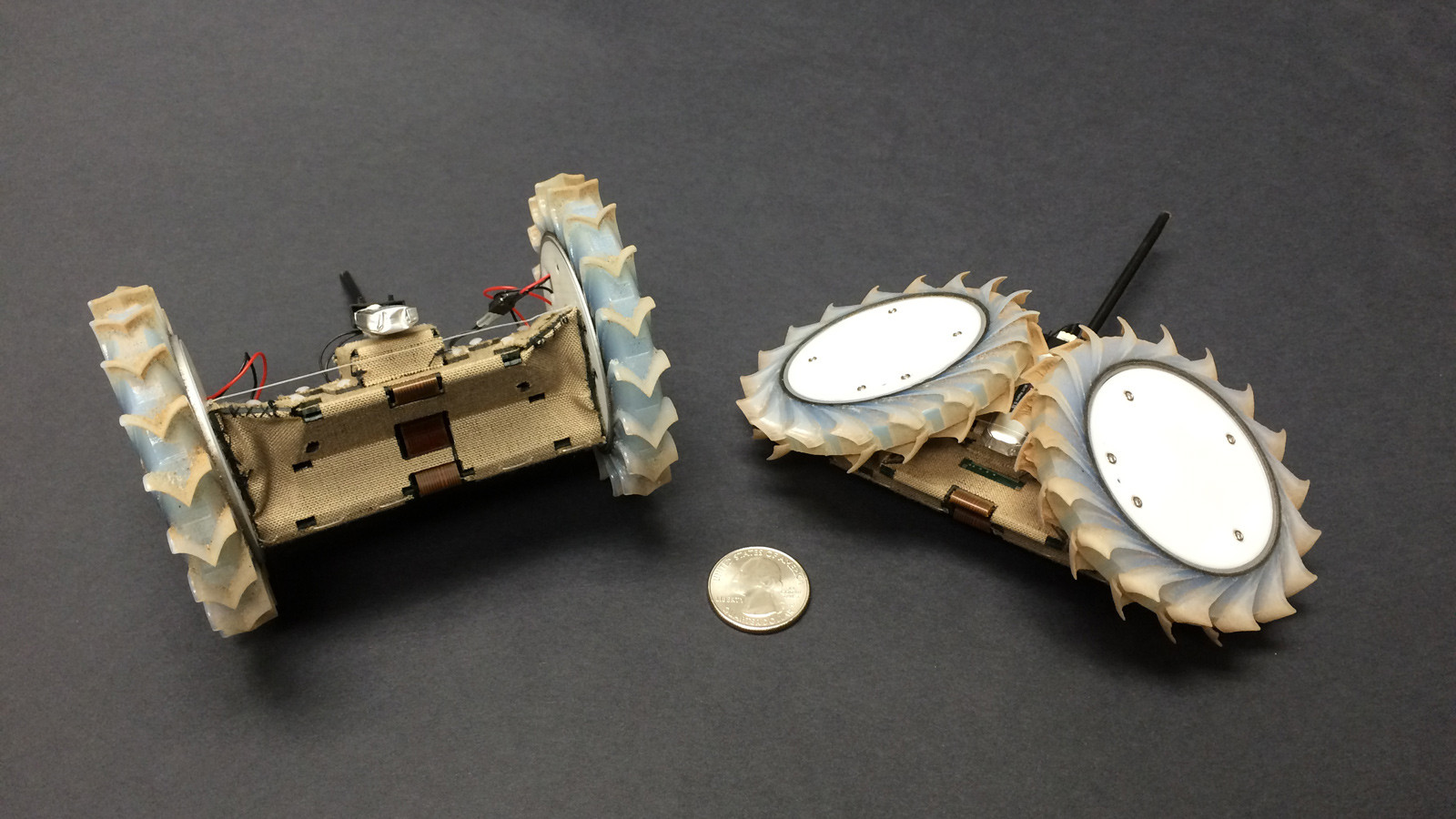
A rover that gets smaller when the gap gets tighter is a lovely bit of engineering. JPL’s PUFFER can lower its body and tuck its wheels over, turning a miniature vehicle into something closer to a crawling card. The photograph above shows both forms. Same design problem, two very different silhouettes.
This is a project worth revisiting for anyone making folding furniture, portable displays, enclosures or little robots. It asks a useful question: does your object really need to keep the same shape while it travels, works and gets packed away?
The context: the original PUFFER story dates to March 2017. Its autonomous successor, A-PUFFER, was tested in 2020. JPL’s current project listing marks the work completed since 2020. These photographs show Earth-based prototypes; they are not evidence of robots already exploring another planet.
A circuit board becomes the body
PUFFER began with Jaakko Karras experimenting with origami. The team replaced paper with a folding circuit board, combining structure and electronics. Its wheels were developed through 3D printing; a stabilising tail and revised wheel geometry helped it negotiate terrain. JPL’s 2017 account describes the idea of carrying several flattened scouts aboard a larger rover, then sending them into awkward places.
What grabs me is the willingness to give one component several jobs. We often design a case, then make brackets to attach electronics inside it, then add more hardware to let the case move. Here, the body and the circuitry were considered together.
That is a useful design direction, even when the right answer for your own project is much simpler. A scored sheet can form a hinge, wall and locating edge. A folded tab can position an insert. The interesting question is which extra part disappears when you change the geometry.
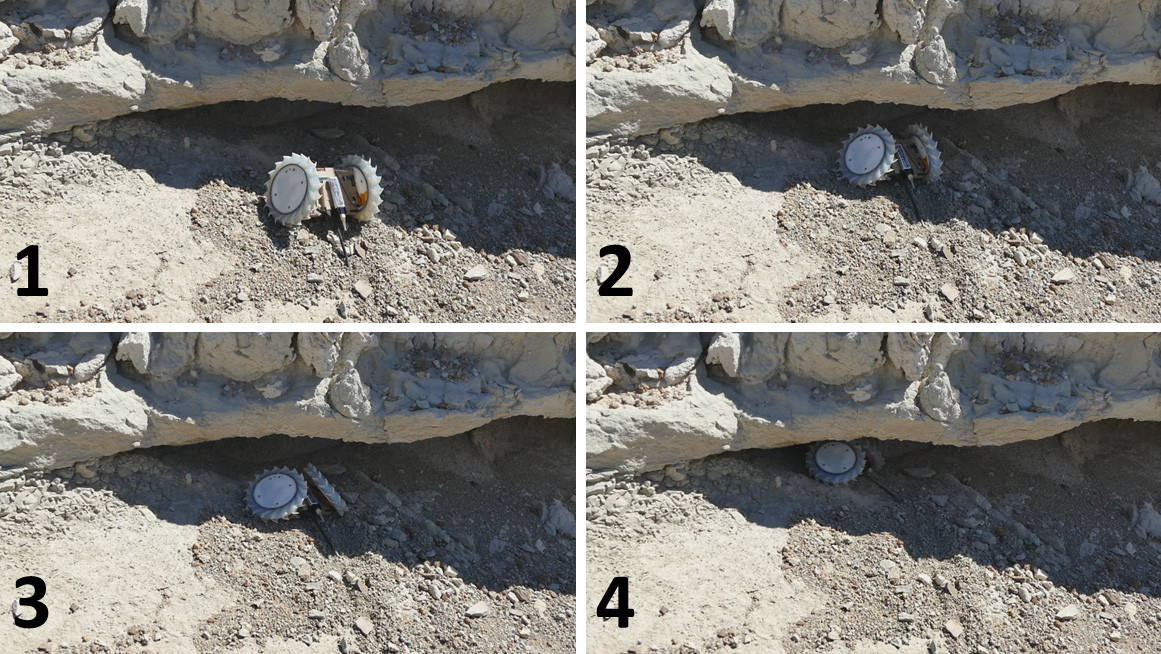
JPL’s original four-frame sequence shows the folding scout entering a rock overhang during field testing. Courtesy NASA/JPL-Caltech.
Courtesy NASA/JPL-Caltech. · JPL image-use permission · Original source. Full composition retained; resized for display.
The gap decides the design
The four-panel field photograph is the payoff. The robot approaches a rock overhang and disappears beneath it. The obstacle makes the folding mechanism’s purpose immediately legible: a taller body would meet the ceiling.
For a maker, that is a better starting point than drawing a clever hinge and then looking for a use. Define the awkward space first. Perhaps a display must fit inside a car boot, a camera mount must pass through a hatch, or a market stall must pack into one storage tub.
Draw those two outlines at the same scale: the shape you need during use and the space available during transport. Put them on top of one another. The disagreement between them tells you where the design needs to move.
Also draw the route between the two positions. A hinge that folds neatly at both ends can still swing through a cable, wheel or neighbouring panel halfway through its travel. That intermediate state is where the cardboard model earns its keep.
The later robots learned to work together
The black robot in the next image is the later A-PUFFER. JPL’s March 2020 report describes upgraded computers, radios and stereo cameras. During February trials, three robots traversed the Mars Yard, collected mapping data and shared maps with a base station, which combined them.
The progression is useful to see. Folding solved a physical access problem. Sensing, communication and mapping addressed what the robots could do once they arrived. Both kinds of engineering mattered, and the photographs show the hardware changing along the way.
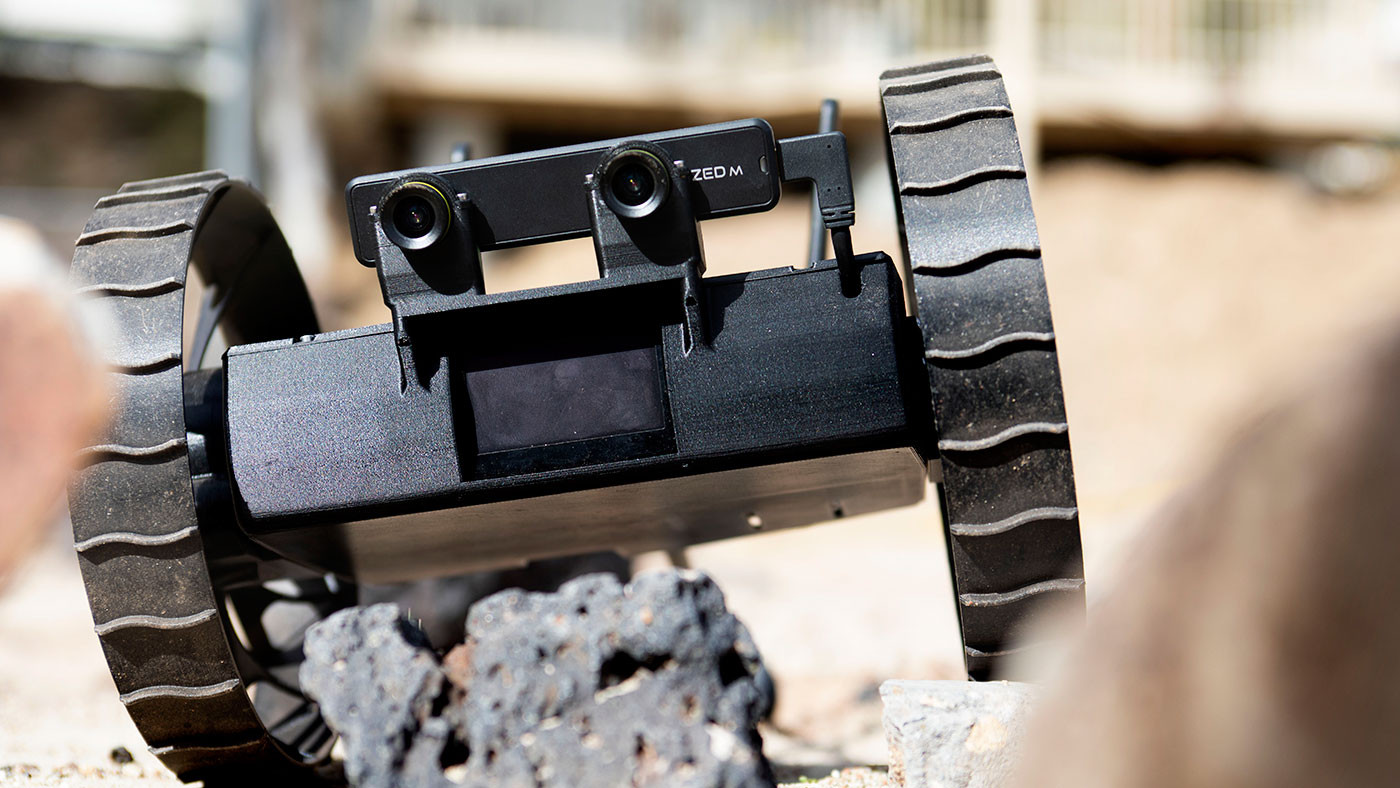
The later A-PUFFER during Mars Yard trials reported in March 2020. These tests took place on Earth. Courtesy NASA/JPL-Caltech.
Courtesy NASA/JPL-Caltech. · JPL image-use permission · Original source. Full composition retained; resized for display.
For your own project, write those functions separately. “Fits through the opening” is one requirement. “Collects a useful photograph on the other side” is another. You can test the first with an empty model. That lets you discover a bad hinge position before committing to the camera, battery and wiring.
Try a folding-body study this afternoon
Pick a real container you already use: a toolbox, drawer or storage tub. Your challenge is to make a small platform that stands upright on your desk and folds to fit inside it. Use scrap card, tape and scissors. This is our suggested exercise, not a NASA build kit.
Start with three card panels: a centre deck and two side panels joined with tape hinges. Add scrap-card blocks representing whatever the finished object must hold. Move the sides through their travel and mark every collision with a pencil. If a cable will cross a hinge, model it with string and leave its ends attached while folding.
Measure the folded width and height, then change one hinge location. Photograph both versions beside a ruler. Your result should be a comparison you can explain: this fold saves space here, but demands extra clearance there. You do not need motors to learn that.
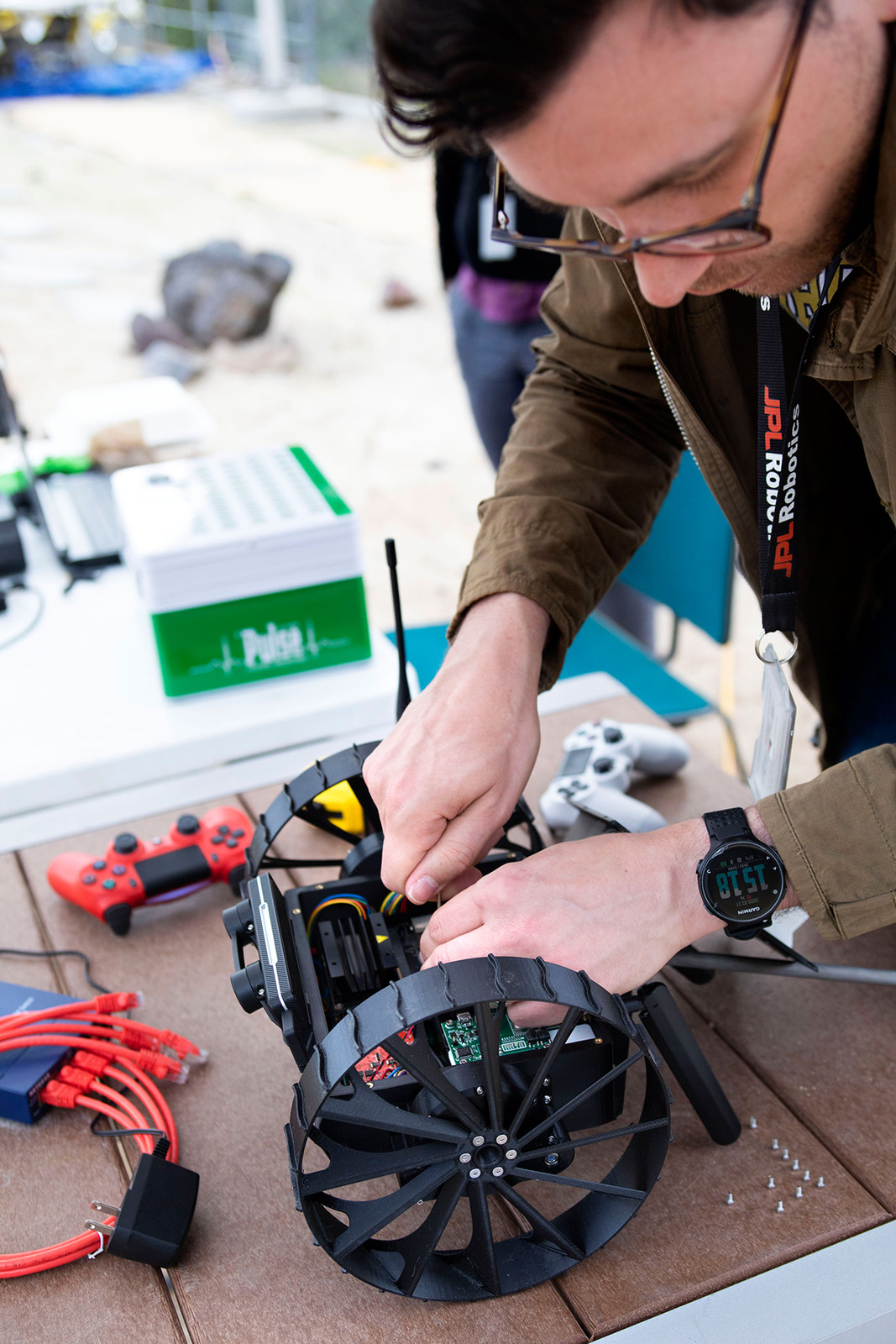
A-PUFFER project manager Jean-Pierre de la Croix works on the robot during the 2020 trials. Courtesy NASA/JPL-Caltech.
Courtesy NASA/JPL-Caltech. · JPL image-use permission · Original source. Full composition retained; resized for display.
The catch, and Sam’s verdict
A cardboard model proves packaging geometry. It does not establish hinge life, terrain performance, electrical reliability or suitability for space. JPL’s test hardware represents engineering far beyond a folding craft project. The public accounts are inspiration and evidence of the concept, not a complete instruction set for reproducing a flight-ready robot.
Sam’s verdict: the fold is worth stealing as a question. Before adding another bracket to a bulky project, ask whether its working shape and its packed shape could be different. Open the original field-test story, study the two positions, then put a piece of card on the bench. A useful mechanism should have an obstacle it actually solves.
Related reading
For another way to bring space engineering onto the bench, explore NASA’s library of downloadable 3D models.
Sources
Share this article
Know someone who would enjoy this? Pass it along.