Photography & Art Direction
The Painting You Can Zoom Into Forever
There are high-resolution images, and then there are images that make you forget you are looking at a painting.
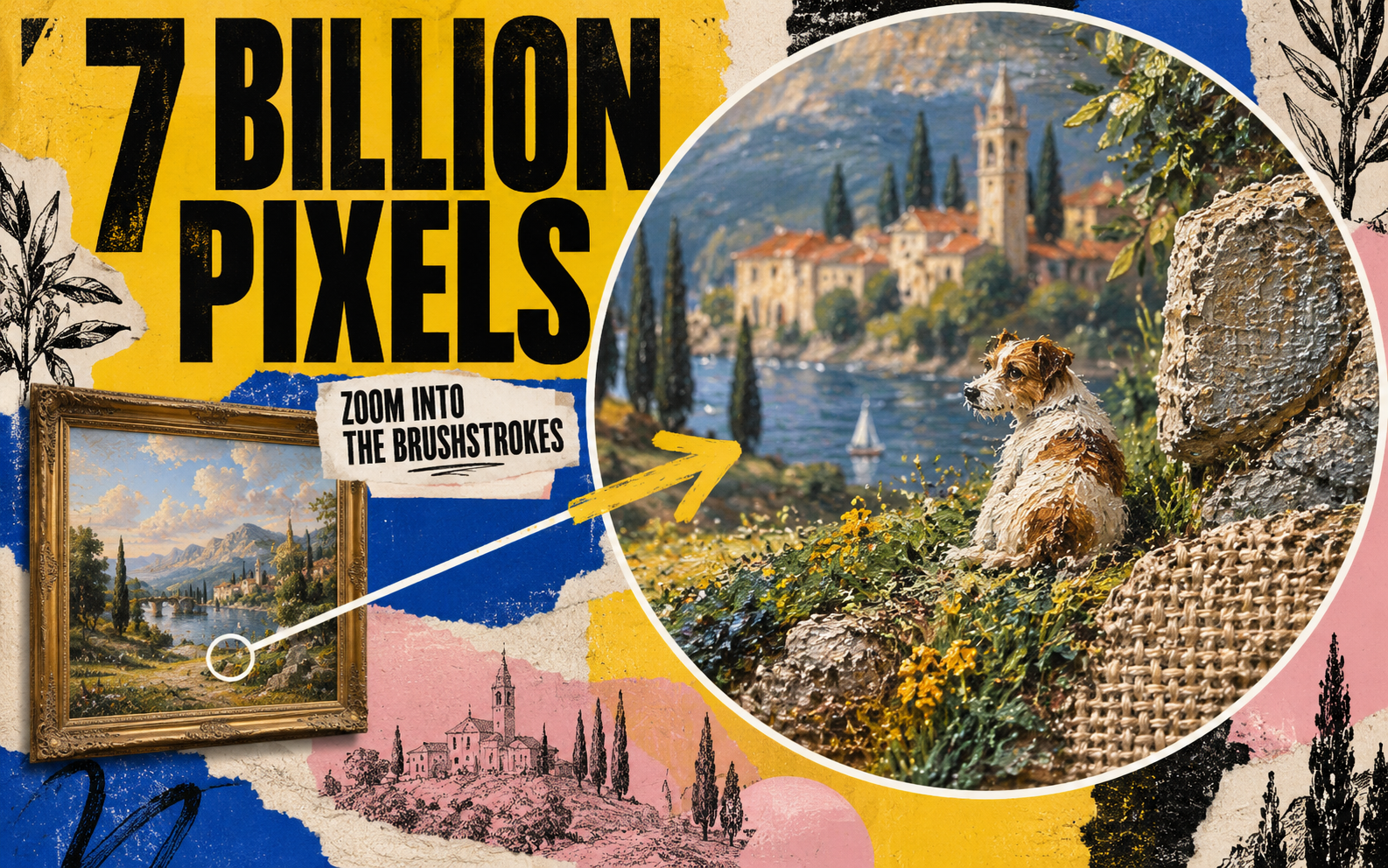
There are high-resolution images, and then there are images that make you forget you are looking at a painting.
Google's Art Project photographed selected artworks at roughly seven billion pixels. That means you can zoom past the overall composition, past the people and buildings, and right into the brushwork, cracks, dust and tiny details that normally disappear behind a museum barrier. Google's own project notes describe the images as around 1,000 times more detailed than an average digital camera.
The fun is not just seeing it bigger
The useful bit for a maker is the change in scale. A painting stops being one flat reference and becomes a library of details: borders, fabrics, faces, animals, lettering, architecture and colour combinations.
You can study how an old artist handled a fold in cloth, how a background was filled without becoming noisy, or how a limited palette still creates depth. It is the same reason I like looking at old signs and packaging close up. Once you get close enough, the clever decisions become visible.
Google Arts & Culture still has gigapixel stories you can open and explore, including collections built around hidden animals and fabric details. Start with The Bestiary.
What I would steal from it
Not the artwork. The process.
Take one detail you like and turn it into a small reference sheet: three colours, two textures, one shape and one idea for where it could go. That might become a laser-engraved border, a fabric repeat, a sticker set or a poster background.
The point is not to make a copy. It is to train your eye to notice the parts that make an image work.
Try this: open one gigapixel artwork, zoom in until the whole painting disappears, and save five details that would still look good as a pattern or cut file.
Useful resource
Open the source: Google Art Project ↗
Start with the primary source, then follow the practical takeaway in this story.
Open resource