
Photography & Art Direction
These Blue Botanical Prints Were Made Without a Camera
Anna Atkins used real seaweed, light and treated paper to make these blue images. Four original museum sheets show what a simple silhouette can teach a designer.
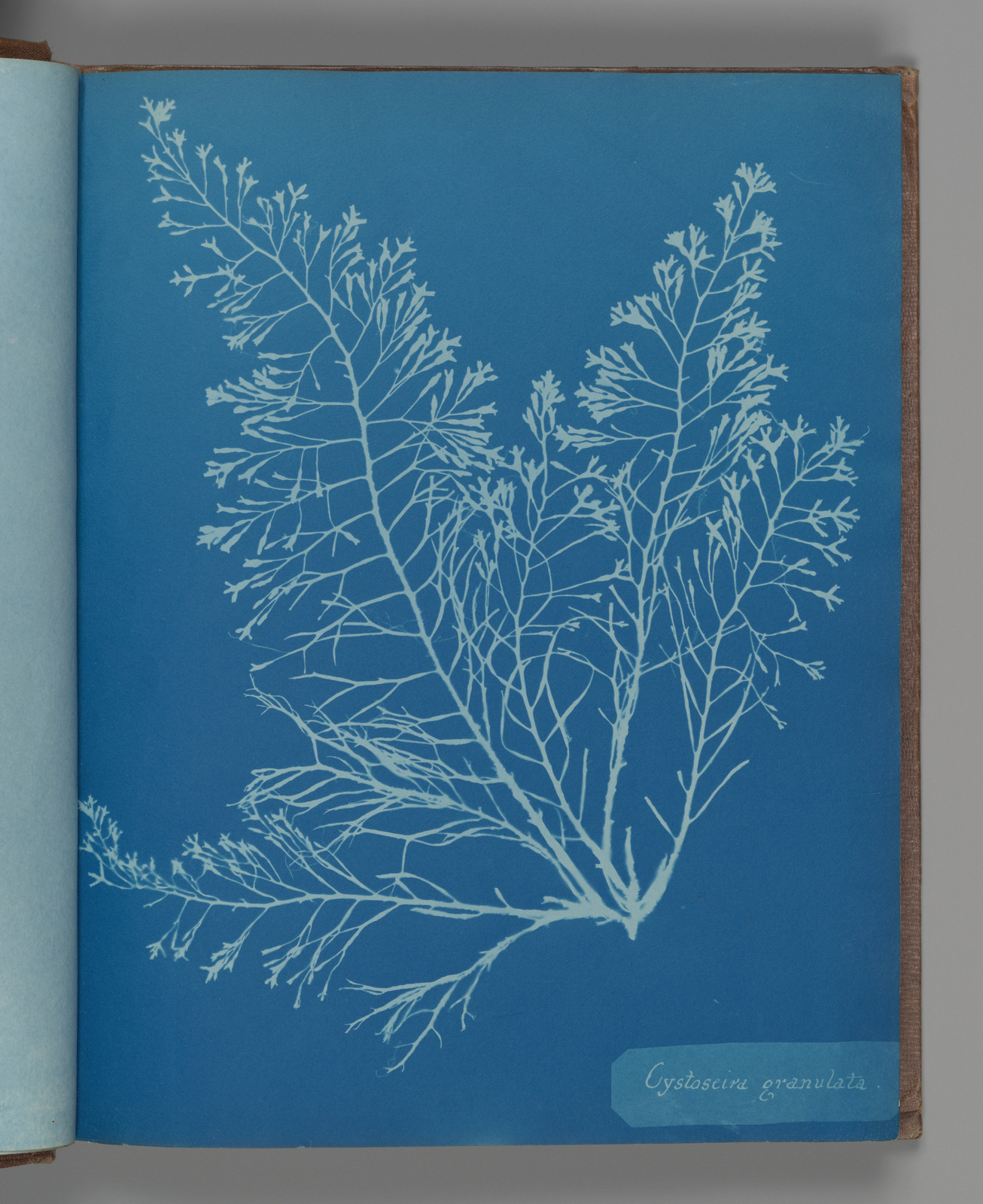
A plant, a sheet of treated paper and sunlight can make an image this detailed. No camera lens is involved. The pale branches are the record of a real specimen blocking light, set against a blue background.
These are cyanotypes by Anna Atkins, digitised from an album in The Metropolitan Museum of Art. The museum dates these four sheets to around 1853. They make a useful discovery for anyone who works with graphics: an actual object can become both the subject and the tool that makes the image. View the first sheet at The Met.
What grabs me is the amount of character in such a small set of ingredients. One colour. One specimen. Plenty of empty paper. If your next design is getting crowded, there is a good lesson here.
What made the blue image?
Cyanotype uses a light-sensitive coating containing iron salts. Light changes the exposed areas; washing develops the recognisable blue-and-pale result. John Herschel introduced the process in 1842, and Atkins began using it for botanical illustrations the following year. MoMA has a short explanation of the process and its history.
Atkins placed specimens directly against sensitised paper. Images made by placing objects on photographic material are called photograms. This direct contact is the trick: the object supplies its own outline, including small gaps and branches that would take patience to draw by hand.
The Natural History Museum describes her 1843 Photographs of British Algae: Cyanotype Impressions as the first book illustrated with photographs. Its account of Atkins and the book is a good place to understand why these pages matter beyond their colour.
Four sheets, four different design decisions
Start with the branching Cystoseira granulata at the top of this article. The specimen spreads across most of the page, yet the blue gaps keep its fine structure readable. Its irregular growth does much of the compositional work. There is no border motif trying to compete with it.
That is something to borrow when making a poster or a small print: choose a subject with an interesting outline before adding decoration around it. A complicated outline and a busy background have to fight for the same attention.
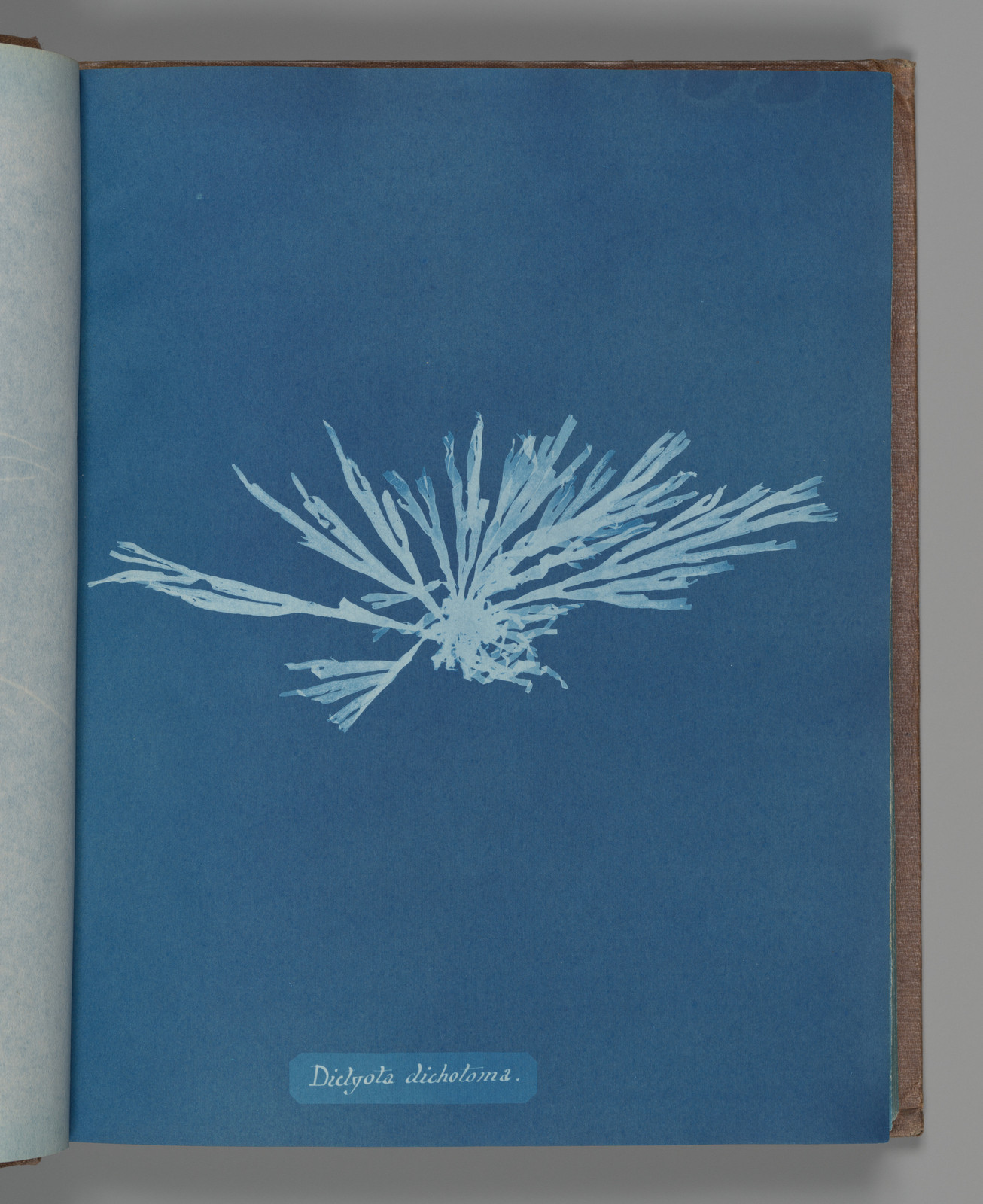
Dictyota dichotoma, ca. 1853: a compact specimen leaves generous space around the form.
Anna Atkins, Dictyota dichotoma, ca. 1853. The Metropolitan Museum of Art. Gilman Collection, Purchase, The Horace W. Goldsmith Foundation Gift, through Joyce and Robert Menschel, 2005. Public domain. · CC0 / The Met Open Access · Original source. Full composition retained; resized for display.
In Dictyota dichotoma, the form is much more compact. Blue space surrounds it on every side, with the label sitting separately below. The specimen feels deliberate because it has room around it. Filling the page would produce a different effect, even if every branch remained unchanged.
For a digital layout, try the same decision twice: one version with the subject almost touching the edges, and another with a generous margin. Judge the whole page at its intended reading size. The second version may make a small subject feel more important.
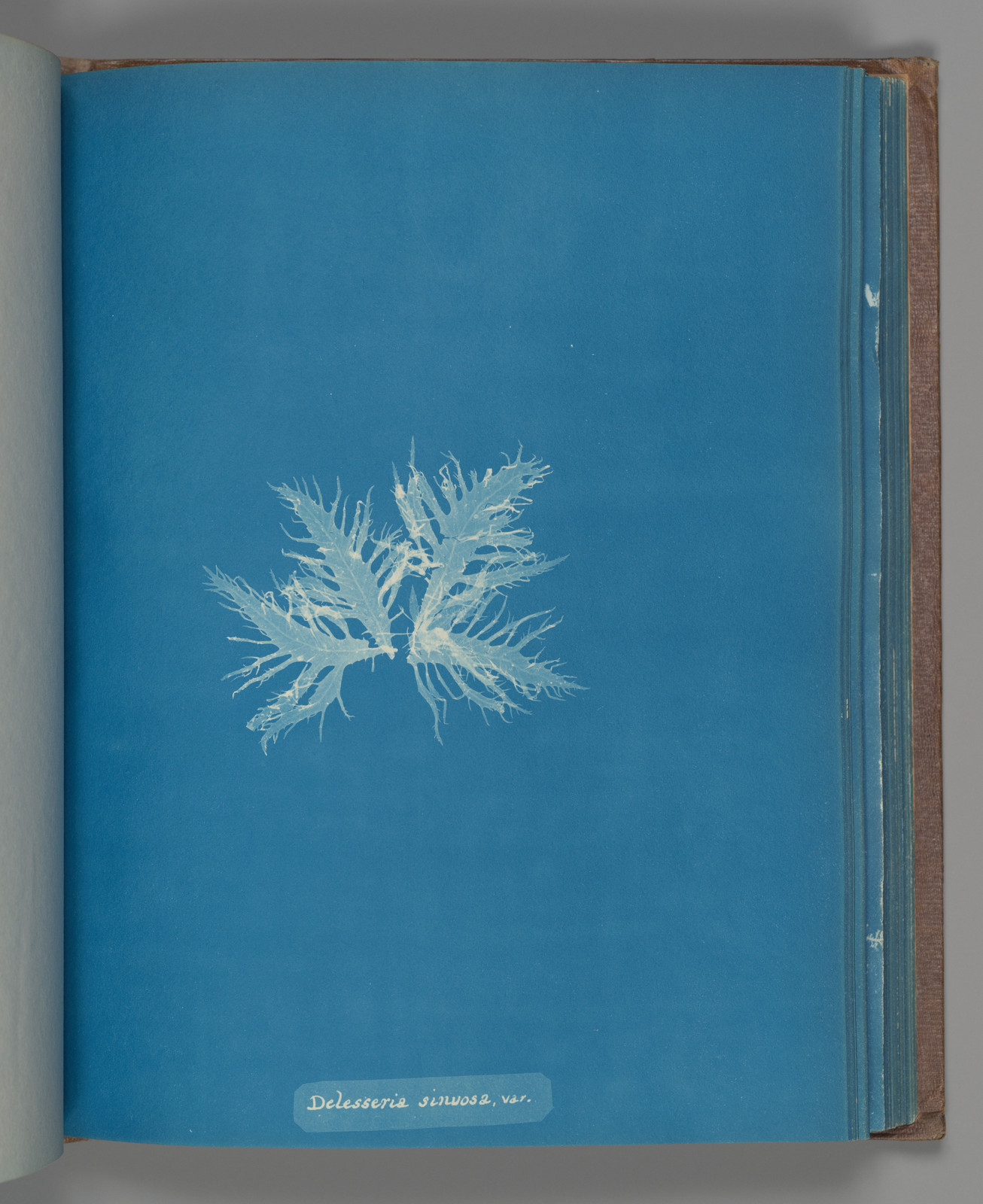
Delesseria sinvosa, var., ca. 1853: the small subject demonstrates how scale changes the balance of a page.
Anna Atkins, Delesseria sinvosa, var., ca. 1853. The Metropolitan Museum of Art. Gilman Collection, Purchase, The Horace W. Goldsmith Foundation Gift, through Joyce and Robert Menschel, 2005. Public domain. · CC0 / The Met Open Access · Original source. Full composition retained; resized for display.
The sheet catalogued as Delesseria sinvosa, var. pushes that idea further. A small, finely divided shape sits in a broad field of blue. Zooming in reveals detail, but the page still works when seen from a distance. That combination is useful when designing an image that has to survive both a thumbnail and a larger view.
The practical question is simple: does your design have a clear overall shape before someone inspects the detail? If the answer depends on zooming in, the composition may need another pass.
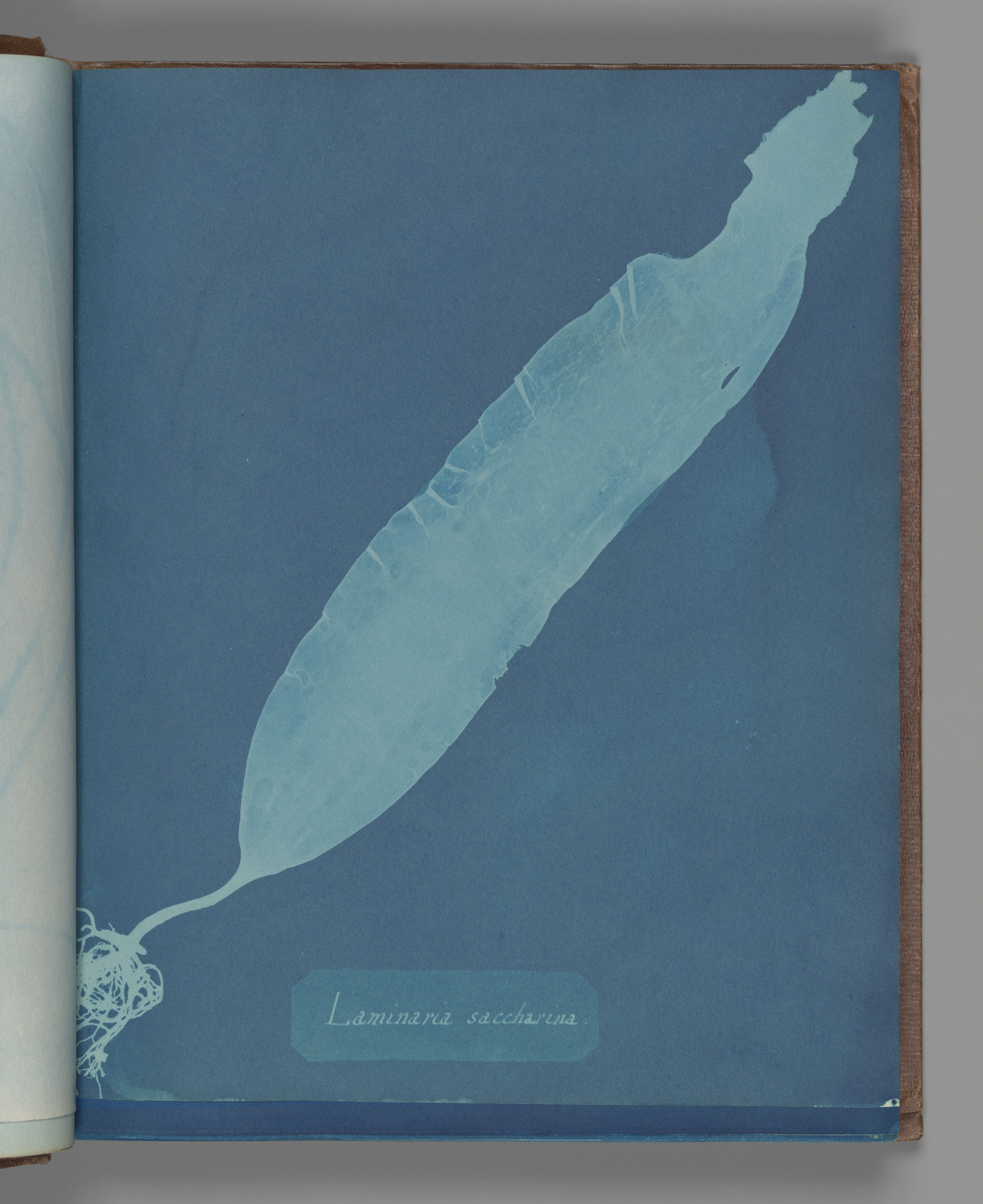
Laminaria saccharina, ca. 1853: one broad diagonal form produces a different composition from the branching specimens.
Anna Atkins, Laminaria saccharina, ca. 1853. The Metropolitan Museum of Art. Gilman Collection, Purchase, The Horace W. Goldsmith Foundation Gift, through Joyce and Robert Menschel, 2005. Public domain. · CC0 / The Met Open Access · Original source. Full composition retained; resized for display.
Laminaria saccharina offers the opposite structure: one broad form runs diagonally across the sheet. The edge and the direction carry the image. Placing it upright in the centre would change its movement, even without changing the specimen itself.
These are observations of the museum images, not results from a cyanotype session in our workshop. The museum images preserve the album edges, paper variation and labels, which are part of what makes them worth looking at closely.
A small experiment you can actually try
If you want to explore the process, the RHS guide to printing with plants starts with pre-coated cyanotype paper. That gives you a manageable first experiment without preparing a chemical coating yourself.
Choose one flat, familiar plant cutting and arrange it on ordinary paper first. Give it space. Move it around until the outline looks interesting. Then use the instructions supplied with your cyanotype paper for handling, exposure, washing and drying. The RHS explains why keeping material flat helps sharpness and why exposure changes with the available light.
For a useful comparison, keep the specimen and paper size the same for two prints. Change only the arrangement. One could be centred; the other could cross the sheet diagonally. Write the exposure details on a separate note. That leaves you with something to compare, rather than two attractive results made under completely different conditions.
There is no single exposure time to promise here. Follow the paper maker's instructions and use a small test before spending a whole pack on one layout.
The catch: the physical print needs care
A blue image can be easy to make and still deserve thoughtful storage. The University of Illinois preservation guide advises keeping cyanotypes away from strong light and using pH-neutral, unbuffered paper enclosures. See its cyanotype preservation section.
For something you want to display for a long time, consider making a digital copy for everyday use and storing the original appropriately. An attractive result is worth keeping, especially when its tiny variations cannot be repeated exactly.
The four Atkins images shown here are public-domain works supplied through The Met's Open Access programme, which releases eligible images under CC0. Their credits and collection links are included with the pictures. That permission applies to these specific images; it does not automatically cover every image found on a museum website.
Try this next: open the RHS cyanotype guide, plan one simple arrangement on plain paper, and see how much of the composition you can solve before light touches the real sheet.
Related reading
The Biodiversity Heritage Library: free botanical prints, insects and old diagrams.
Sources
Share this article
Know someone who would enjoy this? Pass it along.